Reading Tokyo on Foot: The Imperial Palace Loop at Dawn
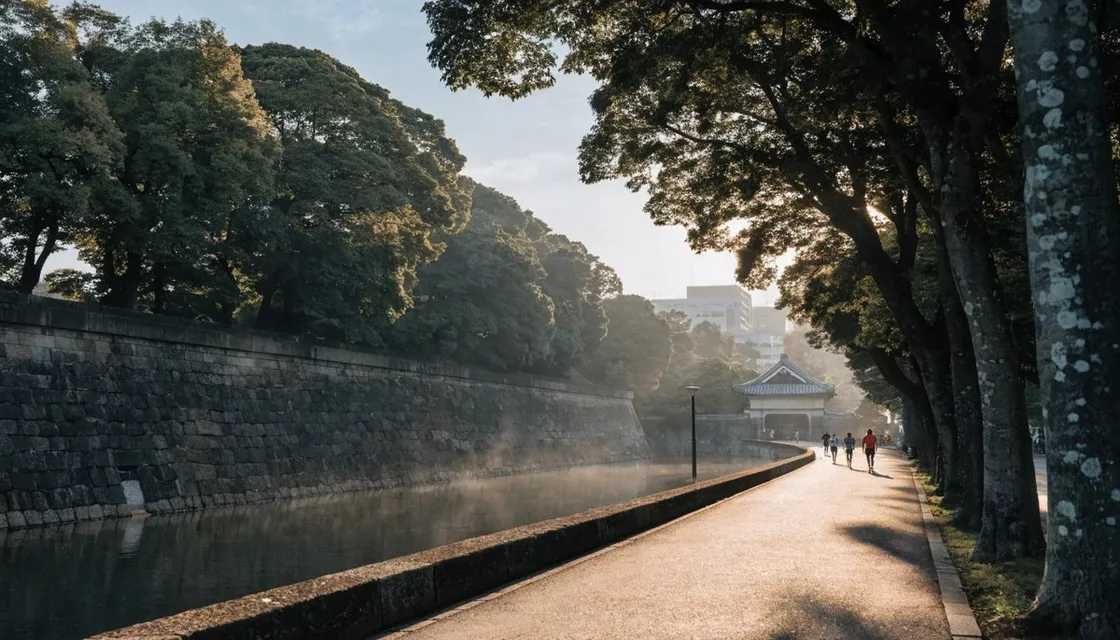
There’s a good habit worth bringing to any new city: run it before you read about it. Moving through a place at dawn, quicker than a walk but slow enough to notice, tells you more than research does. In Tokyo, the five-kilometer loop around the Imperial Palace can hand you the whole city in about a week of mornings.
The loop is flat, car-free, almost exactly measured, and it wraps around the moat at the quiet heart of the megacity. At dawn it fills with a fast, silent, endless stream of office workers and retirees, plus the occasional wheezing newcomer. Everyone runs counter-clockwise. Nobody blasts music into the shared air. Faster runners slip past slower ones without any fuss. It’s Tokyo in miniature: a city that shares space carefully, and without anyone needing to be told.
You can read a city’s mind in how it runs. Tokyo runs early, together, and without complaint.
The loop, and the little thing that makes it work
The loop is the anchor. What makes it so easy to build a routine around is a bit of infrastructure you’ll rarely find anywhere else: run stations. These are small businesses near the course where, for a few hundred yen, you can drop your bag, change, and grab a shower.
That’s the quietly brilliant part. You can commute in with a laptop, stash your clothes, run the loop, rinse off, and walk into a meeting like nothing happened. Of course a city this dense and this serious about both work and ritual would build exactly the tiny thing you need to do both in one morning.
Where the miles actually happen
The Palace gets all the attention, but these are where nomads run most, and what each is good for:
- Yoyogi Park, right by Harajuku: wide, green, and full of a wonderfully random cast of drummers, dancers, and dog walkers. Best for an easy loop where the city melts into trees.
- Komazawa Olympic Park: a proper dedicated jogging course, smooth and forgiving, a touch out of the way. The runner’s-runner choice for steady, honest miles.
- The Arakawa and Tama riversides: long, flat, wide-open paths where the towers fall away and Tokyo suddenly has a horizon. The place to go for distance, and for the rough weeks, when an hour by the water does what no amount of scrolling ever could.
One park near your base for the weekdays, one riverside for the long weekend run. That’s basically the whole system.
What the running teaches
Every city tells you something true about itself if you run it. Tokyo comes across as disciplined, considerate, and quietly built for people willing to show up early and do the small, precise thing every single day. The counter-clockwise loop, the shared silence, the shower you didn’t know you needed. It’s a city that rewards routine, and running is just routine you can actually see.
Which turns out to be the real lesson, and not only about exercise. Tokyo tends to pay off for people who build a repeatable practice and stick with it. Running is one of the cheapest ways to start one, and one of the quickest ways to feel whether this city fits the life you want.
Plenty of people come to Tokyo to work. Running is how a lot of them learn to live here.
A simple starting point
Before the museums and the checklists, a strong first week can go to one simple thing: an alarm you’ll resent, the nearest park or the Palace loop at dawn, and a slow run beside everyone else who takes it seriously. The run station gets added once you want to fold the loop into a working morning.
You’ll understand Tokyo faster from inside a slow lap around an old moat than from any guide, this one cheerfully included.