Capsule Hotels and Net Cafés: Tokyo's Short-Stay Safety Net
Every long stay in Tokyo eventually produces a night with no obvious bed. A lease ends three days before the next one starts.
A meeting in Yokohama runs past the last train. A booking falls through at ten at night.
In most cities that night is expensive and stressful. In Tokyo it is a solved problem, and the solution costs less than dinner.
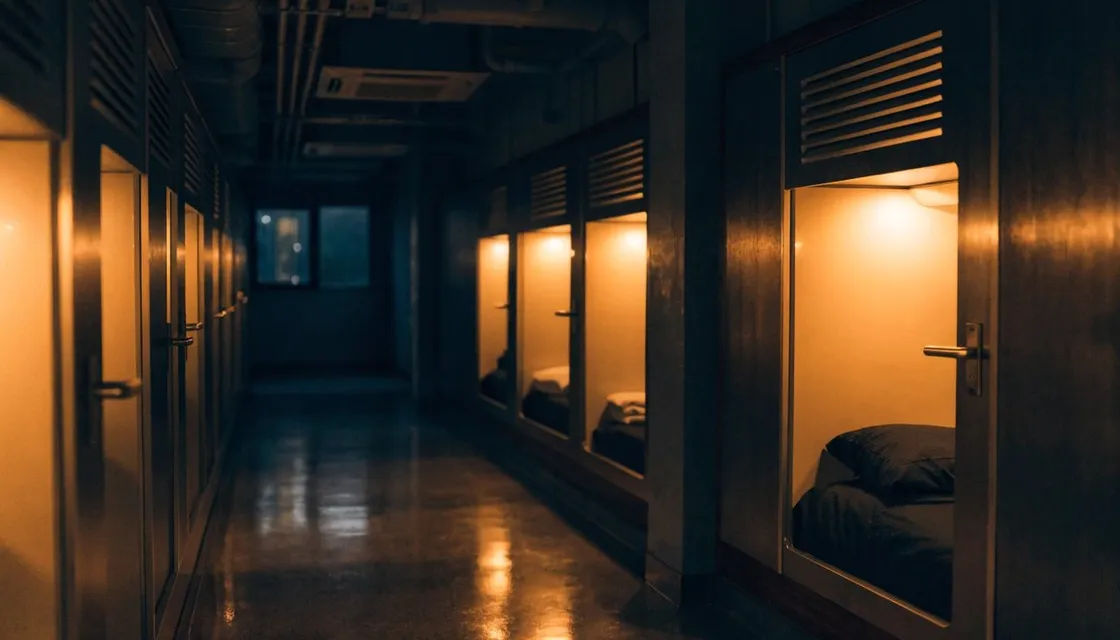
Two institutions handle it. The capsule hotel gives you a small enclosed bunk, a locker, and usually a large communal bath, and it is designed for sleeping.
The net café, sometimes called a manga café or an internet café, gives you a private booth with a reclining seat, a screen, free drinks, and a door that closes, and it is designed for staying. Both are open around the clock, both are everywhere near major stations, and both will take a walk-in.
The city assumes at some point you will need somewhere to be at 1am, and it has quietly built for that.
Which one to use, decided quickly
If you want actual sleep, choose the capsule hotel. You get a flat mattress, a proper duvet, a curtain or shutter, and in most places a bath or sauna that resets a long day.
Expect roughly a few thousand yen for a night, varying widely by area and season, with the newer design-led places charging considerably more.
If you want to be somewhere warm and connected until the trains restart, choose the net café. You are buying a private cubicle by the hour, typically with an overnight package that is the cheapest option in the city.
It is not restful in the way a bed is, but it is private, quiet, and it works.
There is one more consideration many nomads miss: net cafés are also a decent emergency office. If you need a locked door, a wired connection, a printer, and a place to take a call at an odd hour, a booth is a reasonable answer.
How a capsule hotel actually works
You check in at a front desk, hand over your passport if you are a visitor, and receive a key and often a set of house clothes. Shoes come off near the entrance and go into a shoe locker.
Your bag goes into a full-height locker in the changing area, because the capsule itself has very little space and no real security.
The capsule is a bunk-sized alcove, stacked in twos, with a mattress, a light, a socket, and sometimes a small screen or a fan control. You close a curtain or a shutter rather than a door.
It is not a room, and it is not soundproof, but it is far more comfortable than most people expect.
Many capsule hotels include a large communal bath, and some have a full sauna attached. This is a genuine part of the value and worth arriving early enough to use.
The etiquette is the same as a sento: wash thoroughly at a shower stool before entering the shared water, keep the small towel out of the bath, keep your voice down.
A few practical things shape whether the night goes well. Most capsule hotels are single-gender or have strictly separated floors, so couples usually cannot stay together.
Check-in often does not open until the afternoon, and check-out tends to be early. Tattoos may be an issue in the bath area at some properties, so it is worth checking in advance if that applies to you.
How a net café actually works
You choose a booth type at reception. The common options are a reclining chair, a flat mat booth where you can lie down, and sometimes a slightly larger room for two.
Many chains require a membership card on first visit, which usually means showing photo ID and filling in a short form. Bring your passport or residence card.
Pricing is by time block, and the overnight package covering roughly the small hours through morning is where the value is. Soft drinks are almost always free and self-serve.
Food is usually available and inexpensive. Showers exist at many locations for a small extra fee, which turns a net café night into something survivable rather than grim.
The trade-off is honest: the booth has walls but usually not a full ceiling, so you hear the building. The chair reclines but is still a chair.
You will wake up functional, not refreshed. For an unplanned night, that is a fair deal.
Reading the situation at 11pm
The decision usually comes down to timing. If it is late evening and you still have an hour, walking to a capsule hotel and getting a bath and a real sleep is clearly better.
If it is already past midnight and you only need to bridge a few hours until the first train, the net café next to the station wins on convenience alone.
Weekends and event nights are the exception. Capsule hotels near major stations do sell out, particularly when a big concert or a holiday weekend fills the area.
Booking a few hours ahead through a hotel app is a small effort that removes the risk entirely. Net cafés rarely turn people away, but the popular booth types go first.
Knowing both options changes how you plan the evening: the last train stops being a deadline and becomes a preference.
Where they fit into a longer stay
Beyond emergencies, these places quietly solve real gaps. The stretch between a share house checkout and an apartment move-in is the classic one, and a few capsule nights handle it without a full hotel booking.
Early morning flights from Haneda are another, since staying near the station beats a taxi across the city at dawn.
They are also a low-commitment way to try a neighborhood. A couple of nights in a capsule hotel in Nakano or Kuramae tells you more about whether you want to live there than a week of reading listings.
What they are not is a housing strategy. Living out of net cafés is a real and difficult situation for some people in Japan, and it is worth being clear that the short-stay convenience described here is a bridge, not a plan.
FAQ
Do capsule hotels accept foreign visitors without Japanese? Most near major stations do, and many have English signage and self-service check-in machines with an English mode. Smaller neighborhood properties may be Japanese-only at the desk, though the process is simple enough to manage with a translation app.
Can luggage be stored at either? Capsule hotels give you a locker, but large suitcases often need to go to a separate luggage area, and space can be limited. Net cafés generally have no real storage, so coin lockers at the station are the better answer for anything big.
Is the internet good enough for work calls? Net cafés are built around connectivity and are usually reliable, often with a wired option in the booth. Capsule hotels vary more, and the shared lounge tends to be a better place to work than the capsule itself, which has almost no room to open a laptop.